Hidden City Ticketing: Flight Hacks Explained unveils the secrets behind this intriguing travel strategy. This guide delves into the mechanics of booking flights to an intermediate city, disembarking there, and leaving the final leg unused – a potential path to significant savings. We’ll explore the benefits, risks, and legal considerations, providing you with a comprehensive understanding before you embark on your next adventure.
From uncovering hidden city ticket opportunities using various online tools to navigating airport procedures and understanding airline policies, we’ll equip you with the knowledge to make informed decisions. We also discuss alternative strategies for securing affordable airfare, expanding your options beyond this specific technique. This exploration covers everything from utilizing price tracking tools to discovering budget-friendly travel options, including trains, cruises, and unique accommodations.
Understanding Hidden City Ticketing
Hidden city ticketing is a travel strategy where a passenger books a round-trip flight with a connecting flight, intending to only travel to the connecting city and not the final destination listed on the ticket. This often results in a cheaper fare than booking a direct flight to the connecting city alone. While seemingly advantageous, it’s crucial to understand the complexities and potential drawbacks before employing this technique.Hidden city ticketing works by exploiting discrepancies in airline pricing algorithms.
These algorithms often fail to account for the nuances of passengers only using a portion of their booked itinerary. The result is that a flight segment as part of a longer journey might be cheaper than a standalone flight to the same destination. The passenger simply disembarks at the connecting city, leaving the remaining flight segments unused.
Risks and Downsides of Hidden City Ticketing
Employing hidden city ticketing carries significant risks. Airlines generally prohibit this practice, and doing so violates the terms and conditions of your ticket. The most common consequence is the cancellation of your return flight. In some cases, airlines may also cancel your entire itinerary, even the portion you’ve already used. Furthermore, you risk losing your checked baggage if it’s routed to the final destination.
Finally, frequent flyer miles are typically not accrued for the unused portion of the flight. Accumulated negative consequences could also lead to future booking difficulties with the involved airline.
Airline-Specific Success Rates
The likelihood of success with hidden city ticketing varies greatly depending on the airline. Budget airlines are often more likely to detect and penalize this practice, as they may have more robust systems for monitoring passenger behavior. Larger, legacy carriers may have less stringent enforcement, though the risk still remains. It’s difficult to provide a definitive list of airlines where this is more or less successful, as airline policies and enforcement change frequently.
However, using this strategy with any airline carries a degree of risk.
Hidden City Ticketing vs. Direct Booking: A Comparison
| Feature | Hidden City Ticketing | Direct Booking | Notes |
|---|---|---|---|
| Cost | Potentially lower | Generally higher | Significant savings possible, but depends on route and availability. |
| Risk | High (flight cancellation, baggage issues, loss of miles) | Low | Airlines actively monitor and penalize this practice. |
| Convenience | Less convenient (risk of disruptions) | More convenient (straightforward booking and travel) | Potential for significant travel disruption if the airline cancels your return flight. |
| Legality | Technically violates airline terms and conditions | Completely legal and compliant | Airlines reserve the right to cancel tickets booked using this strategy. |
Finding Hidden City Ticket Opportunities
Uncovering hidden city flight deals requires a strategic approach to searching and utilizing online resources. By employing specific techniques and understanding how these platforms work, you can significantly increase your chances of finding substantial savings. This section Artikels effective strategies for locating these often-overlooked opportunities.
Identifying hidden city flights hinges on understanding that the overall price of a multi-city ticket isn’t always directly proportional to the sum of its individual legs. Sometimes, the total cost is lower than booking each segment separately. This discrepancy is what makes hidden city ticketing possible, but it’s important to always be aware of the potential risks involved.
Utilizing Online Travel Agencies for Hidden City Flight Searches
Online travel agencies (OTAs) like Expedia, Kayak, and Priceline are valuable tools in the search for hidden city flights. Their comprehensive databases often reveal pricing anomalies. The key is to experiment with different search parameters. Instead of simply searching for a direct flight from point A to point B, try searching for flights from point A to point C, where point B is an intermediate stop.
If the price of the A-to-C itinerary is cheaper than a direct A-to-B flight, you might have found a hidden city opportunity. Remember to always check the baggage allowance and any other restrictions that may apply to the chosen itinerary.
Leveraging Flight Comparison Websites to Discover Hidden City Deals
Flight comparison websites, such as Google Flights, Skyscanner, and Momondo, are particularly useful for comparing prices across numerous airlines and OTAs simultaneously. These sites often allow for flexible date searches, which can be helpful in identifying price fluctuations and potential hidden city deals. By inputting various combinations of departure and arrival cities, and playing with date ranges, you can increase your chances of uncovering a cheaper option where the final destination is not your intended endpoint.
Pay close attention to the displayed price breakdown to ensure you are getting the best value.
The Impact of Different Search Parameters on Hidden City Ticket Discovery
The effectiveness of finding hidden city tickets relies heavily on manipulating search parameters. Experimenting with different departure and arrival airports within a reasonable distance of your actual destinations can be beneficial. For example, if your target destination is a smaller airport, try searching for flights to a larger, nearby airport. Also, varying the dates of travel, even by a single day, can drastically alter the price.
Consider adjusting the number of passengers and cabin class as well; sometimes, a change in these factors can reveal unexpected savings.
A Step-by-Step Guide to Finding Hidden City Tickets Using a Flight Search Engine
- Choose a Flight Search Engine: Select a reputable flight comparison website like Google Flights, Skyscanner, or Kayak.
- Enter Departure City: Input your desired origin city.
- Enter Arrival City (Hidden City): Enter the city beyond your intended destination. This is crucial for finding the hidden city ticket.
- Select Dates: Input your preferred travel dates.
- Initiate Search: Click the search button.
- Analyze Results: Compare prices with direct flights to your intended destination. If the price to the further city is significantly lower, you may have found a hidden city opportunity.
- Verify Booking Conditions: Carefully review baggage allowances, cancellation policies, and other terms and conditions before booking.
- Book Your Flight: Proceed with booking if the price is favorable and the conditions are acceptable.
Booking and Managing Hidden City Tickets
Booking a hidden city ticket requires careful planning and execution to avoid potential problems. The key is to mimic the behavior of a passenger who intends to complete their entire itinerary, while strategically utilizing the flight’s flexibility to your advantage. Remember, airlines generally frown upon this practice, so discretion is crucial.
Safe and Secure Booking Procedures
Booking a hidden city ticket involves using standard online booking platforms like Expedia, Kayak, or directly through the airline’s website. The crucial step is selecting a multi-city itinerary that includes your desired hidden city as an intermediate stop. Ensure you select only one-way tickets for each leg of the journey, rather than a round-trip, to avoid raising suspicion. Pay close attention to the baggage allowance for each leg, as it may vary.
Choose a payment method you’re comfortable with and secure, and always double-check your booking confirmation for accuracy before proceeding. It’s advisable to use a credit card that offers travel insurance, as this can provide some protection in case of unexpected cancellations or disruptions.
Baggage Management and Checked Luggage
The most significant challenge with hidden city ticketing lies in managing checked luggage. Airlines typically do not allow passengers to collect checked bags at an intermediate stop and continue their journey without the bag. Therefore, you must carefully plan to only take carry-on luggage. If you absolutely must check luggage, consider shipping your bags separately to your final destination.
This is more expensive but ensures you don’t risk losing your luggage. Alternatively, you could leave checked luggage at your intended “hidden city” and collect it later, but this requires extra planning and coordination.
Navigating Airport Procedures, Hidden City Ticketing: Flight Hacks Explained
When using a hidden city ticket, it’s essential to behave as if you’re continuing your journey. Avoid making any overt attempts to disembark at your “hidden city” and act like you’re a typical passenger transferring to your connecting flight. Don’t linger near the gate, and if questioned by airline staff, maintain a calm and straightforward demeanor, providing truthful information about your intended destination (the final destination on your itinerary).
It’s crucial to avoid any behavior that might draw suspicion.
Booking and Management Process Flowchart
A flowchart illustrating the process would visually represent the steps involved. The flowchart would begin with “Search for Multi-City Flights,” branching to “Select One-Way Flights with Hidden City as Intermediate Stop,” followed by “Review Baggage Allowance and Restrictions.” The next step would be “Book Flight and Secure Payment,” leading to “Confirm Booking and Itinerary.” Finally, a branch would indicate “Manage Carry-On Baggage Only” or “Arrange Separate Baggage Shipping.” This visual representation would clearly show the key decision points and actions required for successfully booking and managing a hidden city ticket.
Legal and Ethical Considerations
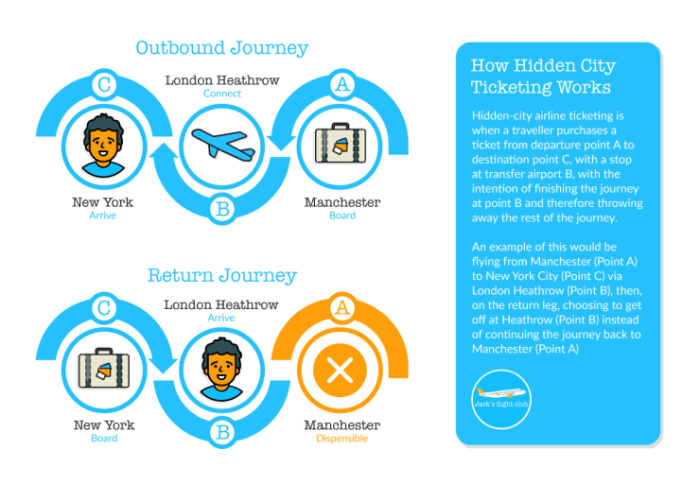
Hidden city ticketing, while seemingly a clever way to save money, operates in a gray area concerning airline regulations and ethical practices. Understanding the potential legal and ethical ramifications is crucial before employing this strategy. Airlines generally do not explicitly endorse this practice, and passengers should be aware of the potential consequences.Airlines’ terms and conditions often prohibit activities that circumvent their intended fare structures.
While not always explicitly mentioning “hidden city ticketing,” the clauses regarding ticket misuse or unauthorized changes frequently apply. These terms generally give airlines the right to cancel tickets, revoke frequent flyer miles, and even deny future travel on their services.
Airline Terms and Conditions and Potential Consequences
Airlines typically have extensive terms and conditions that passengers agree to upon purchasing a ticket. These agreements often include clauses prohibiting activities that violate the intended use of the ticket, such as deliberately abandoning a portion of the itinerary. Violation of these terms can result in a range of consequences, including ticket cancellation, forfeiture of any remaining flight segments, loss of associated baggage allowance, and denial of future bookings with that airline.
In some cases, penalties may also apply. For example, an airline might impose a fee for rebooking or refuse to refund the unused portion of the ticket. The specific consequences vary depending on the airline’s policies and the severity of the violation.
Impact on Frequent Flyer Programs and Loyalty Points
The impact of hidden city ticketing on frequent flyer programs is significant. Most airline loyalty programs award points based on the total distance flown or the fare paid for a particular flight. Using hidden city ticketing effectively misrepresents the actual travel undertaken. Airlines may detect this practice through their data systems, and, upon detection, may choose to revoke accumulated miles or points earned on that specific flight, or even retroactively deduct miles from your account for previous flights if a pattern of hidden city ticketing is identified.
This could significantly impact your ability to redeem awards or reach elite status. Furthermore, frequent flyer program terms and conditions often explicitly prohibit such practices.
Risks of Denied Boarding and Penalties
While not always immediately apparent, the risk of being denied boarding or facing penalties for using hidden city ticketing is real. Airlines employ sophisticated systems to track passenger itineraries. If an airline suspects hidden city ticketing, they may refuse to allow a passenger to board their flight. This could lead to missed connections, significant travel disruptions, and financial losses.
Additionally, the airline may impose financial penalties, such as charging for a new ticket or imposing a no-show fee. The risk is heightened when using connecting flights, as the airline may discover the intended itinerary during check-in or baggage handling processes.
Potential Legal and Ethical Concerns
A list of potential legal and ethical concerns related to hidden city ticketing includes:
- Breach of contract: Passengers implicitly agree to the terms and conditions of the airline when purchasing a ticket. Hidden city ticketing can be interpreted as a breach of this contract.
- Fraudulent activity: In some cases, using hidden city ticketing might be considered fraudulent, particularly if done with the intent to deceive the airline.
- Unfair business practice: Hidden city ticketing takes advantage of airline pricing algorithms and could be considered an unfair business practice.
- Potential for disruptions: Hidden city ticketing can cause disruptions to airline operations, such as empty seats on connecting flights.
Alternative Travel Strategies
Finding cheap flights doesn’t solely rely on hidden city ticketing. Numerous strategies can significantly reduce airfare costs, offering flexibility and potentially even better deals than those unearthed through more complex methods. This section explores several effective methods for securing inexpensive airfares, along with resources and tools to assist in your search.
Effective Methods for Finding Inexpensive Airfare
Several proven methods exist for securing lower airfares. These strategies involve flexible travel planning, utilizing specific search tools, and understanding pricing patterns. By employing a combination of these techniques, you can dramatically improve your chances of finding the best possible deals.
- Be Flexible with Travel Dates: Mid-week flights (Tuesday and Wednesday) and off-season travel generally offer lower prices than peak periods or weekend travel. Consider adjusting your departure and return dates by a day or two to see if prices change significantly.
- Consider Alternative Airports: Flying into a smaller, less popular airport near your destination can often result in lower fares. Be sure to factor in the cost and time of transportation from the airport to your final destination.
- Book in Advance or at the Last Minute (Strategically): While booking well in advance often secures better prices, last-minute deals can sometimes appear, particularly for less popular routes. Monitor prices closely to determine the optimal booking window for your specific travel plans.
- Clear Your Browser History and Cookies: Airlines and travel websites often track your searches, potentially increasing prices based on your browsing history. Clearing your cookies and browsing in incognito mode can help avoid this phenomenon.
- Utilize Flight Comparison Websites: Websites like Google Flights, Skyscanner, Kayak, and Momondo compare prices from various airlines and travel agencies, allowing you to easily identify the best deals. These tools often offer flexible date searches and price alerts.
Websites and Tools for Discovering Flight Deals
Several websites and tools specialize in finding flight deals and discounts. These resources employ advanced algorithms and data analysis to identify the best prices, often uncovering hidden deals not readily apparent through traditional search methods. Using a combination of these tools maximizes your chances of finding the lowest fares.
- Google Flights: Provides a comprehensive search engine with flexible date options, price tracking, and map views to visualize flight routes and prices.
- Skyscanner: Offers a similar functionality to Google Flights, known for its global reach and ability to find deals on budget airlines.
- Kayak: Combines flight searches with hotel and car rental options, making it a convenient one-stop shop for travel planning.
- Momondo: Another metasearch engine that compares prices from various sources, often highlighting hidden deals and less-known airlines.
- Scott’s Cheap Flights (Subscription Service): A subscription-based service that alerts users to exceptionally low airfares, often uncovering deals not easily found through standard search engines. The cost of the subscription is often offset by the savings on flights.
Comparison of Strategies for Securing the Best Flight Prices
Different strategies for securing the best flight prices have varying degrees of effectiveness, depending on factors such as travel dates, destination, and personal preferences. A comparison highlights the strengths and weaknesses of each approach.
| Strategy | Strengths | Weaknesses |
|---|---|---|
| Flexible Dates | Higher chance of finding lower fares | Requires flexibility in travel plans |
| Alternative Airports | Potentially lower fares | Requires additional transportation costs and time |
| Advance Booking | Generally secures better prices | Less flexibility if plans change |
| Last-Minute Booking | Potential for unexpectedly low fares | Higher risk of limited availability and higher prices |
| Flight Comparison Websites | Convenient comparison of various options | May not always find the absolute lowest fare |
Using Price Tracking Tools to Monitor Flight Costs
Price tracking tools are invaluable for monitoring flight costs over time. These tools automatically track prices for specific flights, notifying you of price drops or increases. This allows for informed decision-making, ensuring you book at the most opportune moment.
Most major flight comparison websites (Google Flights, Kayak, Skyscanner) offer built-in price tracking features. You simply input your desired flight details, and the tool will send you email alerts or push notifications when the price changes. Some services, like Hopper, specialize in price prediction and suggest the best time to book based on their analysis of historical data. By utilizing these tools, you can avoid overpaying for flights and secure the best possible price.
Exploring Other Travel Options
Beyond the realm of flights, numerous budget-friendly travel alternatives exist, offering unique experiences and the chance to explore the world in diverse ways. This section explores several such options, providing insights into their costs and benefits.
Budget-Friendly Train Travel Destinations
Train travel offers a scenic and often more relaxed alternative to flying. The following destinations are particularly well-suited for budget-conscious travelers who appreciate the charm of rail journeys.
- Southeast Asia (Thailand, Vietnam, Laos): Extensive and affordable rail networks connect major cities and towns, allowing travelers to explore ancient temples, bustling markets, and stunning landscapes at a leisurely pace. Overnight sleeper trains further reduce accommodation costs.
- Europe (Interrail): The Interrail pass provides access to extensive rail networks across Europe, making it ideal for exploring multiple countries. While the pass itself has a cost, it can be significantly cheaper than individual tickets, especially for longer trips.
- Japan (Japan Rail Pass): Similar to Interrail, the Japan Rail Pass offers cost-effective travel across Japan’s efficient and scenic rail system. It’s perfect for experiencing the country’s diverse landscapes and vibrant cities.
- India: India’s extensive rail network is known for its affordability and allows access to a vast range of cultural experiences. Traveling by train is an integral part of Indian life and offers a unique cultural immersion.
- Canada (VIA Rail): Canada’s VIA Rail offers scenic routes across the country, showcasing stunning landscapes from the Rockies to the Atlantic coast. While not as cheap as some Asian options, it’s still a relatively affordable way to see vast distances.
Diverse Cruise Ship Experiences
Cruises cater to a wide range of budgets and preferences. The following examples illustrate the variety available:
- Budget-Friendly Cruises (Caribbean): Many cruise lines offer shorter Caribbean cruises with basic amenities at significantly lower prices than luxury options. These often focus on sun, sand, and beach activities, making them a great value for a relaxing getaway. Expect smaller cabins and fewer onboard amenities.
- Mid-Range Cruises (Mediterranean): Mediterranean cruises offer a blend of culture, history, and relaxation. Mid-range options provide a comfortable experience with a good selection of amenities, dining options, and shore excursions. Cabins are generally larger and more comfortable than budget options.
- Luxury Cruises (Alaska): Luxury cruises to Alaska offer an unparalleled experience, with spacious suites, gourmet dining, and a range of exclusive onboard activities and shore excursions. These cruises cater to travelers seeking a premium experience and are significantly more expensive than budget or mid-range options. Expect butler service, fine dining, and private balconies.
Scenic Road Trip: Pacific Coast Highway (California)
A road trip along California’s Pacific Coast Highway offers stunning coastal views, charming towns, and diverse activities.
Itinerary (7 Days):
- Los Angeles to Santa Barbara (Day 1): Explore Hollywood, drive along the coast, and enjoy Santa Barbara’s beaches.
- Santa Barbara to Big Sur (Day 2-3): Drive the iconic Big Sur coastline, hike to scenic viewpoints, and enjoy the dramatic cliffs.
- Big Sur to Monterey/Carmel (Day 3-4): Visit the Monterey Bay Aquarium, explore the charming town of Carmel, and enjoy the 17-Mile Drive.
- Monterey/Carmel to San Francisco (Day 4-5): Drive to San Francisco, explore the Golden Gate Bridge, and visit Fisherman’s Wharf.
- San Francisco (Day 5-6): Explore San Francisco’s diverse neighborhoods, ride a cable car, and visit Alcatraz Island (optional).
- San Francisco to Los Angeles (Day 6-7): Drive back to Los Angeles, with optional stops along the way.
Budget Breakdown (Estimate for two people):
- Gas: $300-$400
- Accommodation (mix of hotels/motels): $700-$1000
- Food: $500-$700
- Activities/Attractions: $300-$500
Total Estimated Cost: $1800-$2600
Budget Accommodation Comparison
The table below compares the costs and benefits of different budget accommodation options.
| Accommodation Type | Cost (per night) | Pros | Cons |
|---|---|---|---|
| Hostel | $20-$50 | Social atmosphere, budget-friendly, often in central locations | Shared rooms, limited privacy, potential noise |
| Guesthouse | $50-$100 | More privacy than hostels, often charming and locally owned, sometimes includes breakfast | Can be less centrally located than hotels, fewer amenities |
| Budget Hotel/Motel | $70-$150 | Private room and bathroom, more amenities than hostels or guesthouses | Can be less charming than guesthouses, may lack character |
| Airbnb | Variable | Variety of options, can be more spacious than hotels, often includes kitchen facilities | Prices vary widely, cleanliness can be inconsistent, may require extra cleaning fees |
Unique Accommodation Options: Hidden City Ticketing: Flight Hacks Explained
Choosing the right accommodation can significantly enhance your travel experience. Beyond standard hotels, a world of unique and memorable lodging options awaits, each offering a distinct character and appeal. This section explores several alternatives, comparing their advantages and disadvantages, and providing insights into planning and booking.
Five Unique Vacation Rental Experiences
Several alternatives to traditional hotels provide distinctive and memorable vacation experiences. These options cater to diverse preferences and budgets, allowing travelers to personalize their stay.
- Treehouses: Offering a whimsical escape, treehouses provide a connection with nature, often featuring stunning views and a secluded ambiance. The experience can be rustic or luxurious, depending on the specific location and amenities.
- Yurts: These circular, tent-like structures offer a blend of comfort and nomadic charm. Typically found in scenic locations, yurts provide a unique cultural experience, often incorporating traditional design elements.
- Cabins: Rustic cabins offer a cozy and secluded retreat, often nestled in forests or mountainous regions. They typically feature fireplaces and offer opportunities for hiking and outdoor activities.
- Glamping Tents (Luxury Camping): Glamping combines the charm of camping with the comforts of a hotel room. These luxurious tents often feature comfortable beds, private bathrooms, and other amenities, offering a unique outdoor experience without sacrificing comfort.
- Castles/Historic Mansions: For a truly unique experience, consider staying in a historic castle or mansion. These offer a glimpse into the past, with stunning architecture and often luxurious amenities.
Airbnb versus Traditional Hotels
Airbnb and traditional hotels cater to different needs and preferences. Airbnb offers a wider range of accommodation types and often provides a more local and immersive experience. Hotels, on the other hand, typically offer more consistent service and amenities.
| Feature | Airbnb | Traditional Hotels |
|---|---|---|
| Price | Can be cheaper or more expensive depending on location and demand | Generally consistent pricing, though subject to seasonal fluctuations |
| Amenities | Varies greatly; some offer few amenities, others offer luxurious ones. | Generally consistent amenities within a given star rating |
| Privacy | Varies; some are entire homes, others are private rooms in a shared space. | Generally more private, with individual rooms and bathrooms. |
| Consistency | Can be inconsistent; quality varies between hosts. | More consistent service and amenities. |
The Ritz-Carlton, Half Moon Bay Review
The Ritz-Carlton, Half Moon Bay, offers a luxurious coastal escape with stunning ocean views. Strengths include impeccable service, spacious rooms, and world-class dining options. However, the location’s relative isolation might be a drawback for those seeking easy access to city attractions. The high price point is also a significant consideration.
RV and Camper Travel
RV and camper travel offers unparalleled freedom and flexibility, allowing you to explore at your own pace. Careful planning is crucial, however, including route selection, campground reservations, and maintenance schedules. Potential challenges include finding suitable campsites, managing waste disposal, and dealing with unexpected mechanical issues.
Houseboat and Yacht Stays
Houseboat and yacht stays provide unique perspectives and experiences, offering a chance to explore waterways and enjoy on-water activities. Costs vary greatly depending on the size and luxury of the vessel, as well as the location and duration of the stay. Booking processes typically involve specialized rental agencies or private owners, requiring advance planning and careful consideration of insurance and liability.
Mastering the art of hidden city ticketing requires careful planning and awareness of potential pitfalls. While the potential for savings is enticing, understanding the risks involved is crucial. Ultimately, this guide empowers you to make informed choices about your travel strategies, whether you choose to explore the world through hidden city flights or by employing alternative, equally budget-friendly methods.
Remember, informed travel decisions lead to smoother, more enjoyable journeys.
FAQ Explained
What happens to my checked baggage if I use a hidden city ticket?
Airlines typically won’t forward your checked baggage to your final destination if you use a hidden city ticket. You’ll need to collect it at your intended disembarkation point.
Can I use frequent flyer miles or points for hidden city tickets?
It’s generally not recommended. Many airline programs have clauses that could void your miles or points if you don’t complete the entire itinerary.
What if my connecting flight is delayed or canceled?
Your responsibility rests solely on reaching your intended destination. The airline is unlikely to assist with rebooking if you don’t complete the entire ticket.
Are hidden city tickets always cheaper?
Not necessarily. The savings depend on the specific route and availability. Sometimes, direct booking offers better deals.
What are the chances of getting caught using a hidden city ticket?
The chances vary. Airlines may not always notice, but there’s a risk of penalties or being denied boarding in the future.